Gearmotors.ca is published by SEW-EURODRIVE Canada. Product examples refer to SEW-EURODRIVE; the guidance applies to equipment from any manufacturer. About this site
Short answer: Repair a failed gearmotor when the damage is wear-related, the repair quote is well below the price of a new unit (many plants draw the line at roughly 55–65% of new), and parts are available. Replace it when the housing or shafts are structurally damaged, the repair would cost more than that, or the model is obsolete. Then pick the repair method that matches how much downtime the asset can tolerate.
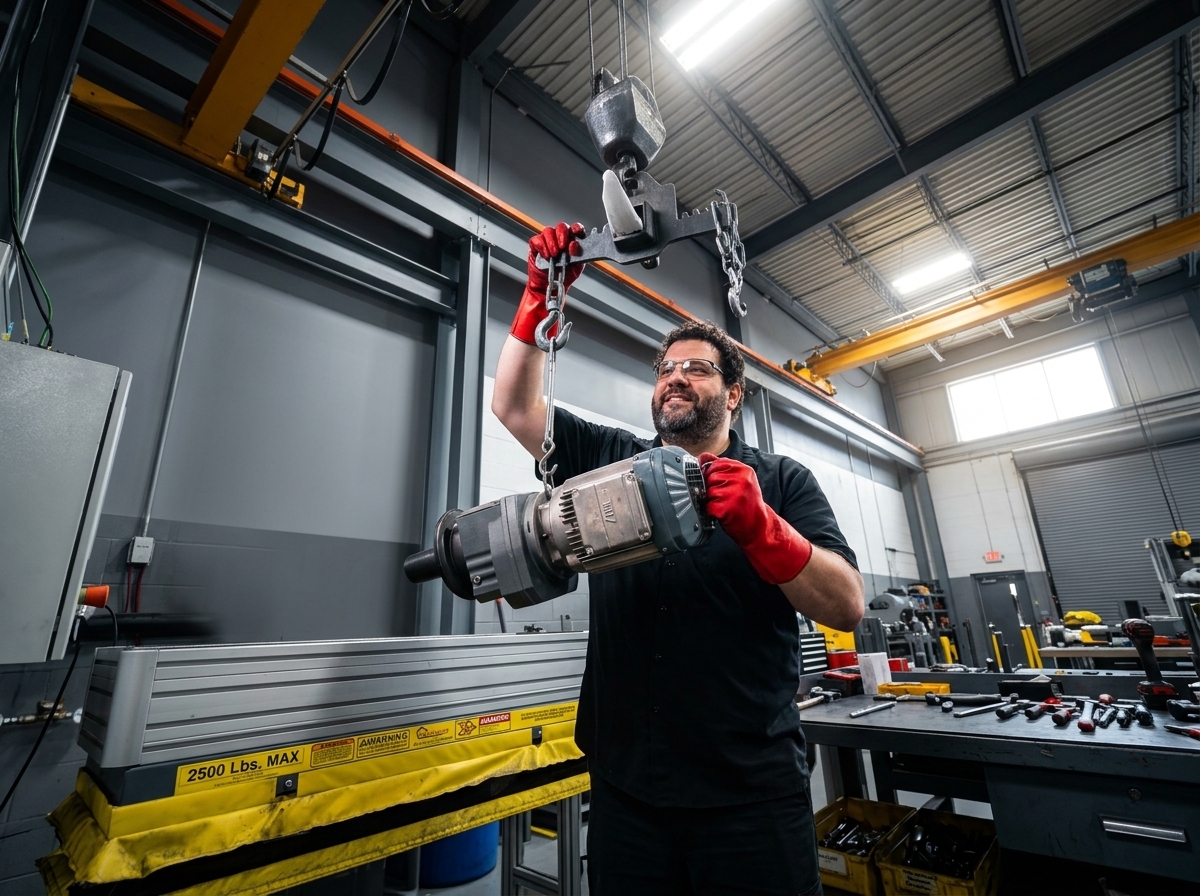
How do you decide whether to repair or replace a failed gearmotor?
The expensive mistake is rarely the repair itself. It’s making the call under pressure. Work through these five questions in order, ideally before a failure, so the answer is ready when one happens.
1. What caused the failure?
The failure mode sets the limits of what a repair can achieve.
- Wear-related (worn bearings or seals, early gear tooth pitting that hasn’t spread): usually repairable.
- Contamination (water, washdown chemicals or debris inside the unit): often repairable if caught early, but check bearings and gears for secondary damage.
- Structural or catastrophic (cracked housing, sheared shaft, several components failing at once): usually points to replacement.
Whatever you decide, record the root cause. A gearmotor that keeps failing the same way needs a change to its application or environment, not just another repair.
2. How does the repair quote compare with the price of a new unit?
Most plants use a percentage-of-new rule. In EASA’s research on electric motor repair, end users were willing to spend on average up to about 56% of the price of a new motor on a repair before leaning toward replacement, and many repair shops work to a threshold of roughly 60–65% of comparable new. (Sources are listed at the end.)
Treat this as a starting point. Small, standard gearmotors are often cheaper to replace than to strip down. Large, custom or high-value gear units are frequently worth remanufacturing when the housing and main components are sound.
3. How critical is the asset?
- Does its downtime stop the whole line, or one station?
- What does an hour of downtime on this asset actually cost?
- Is there a spare on the shelf, or redundancy built in?
The same failure can justify different decisions on two different machines.
4. Are parts or a replacement available, and how quickly?
For older or discontinued models, original parts can take weeks. In Canada, units or parts that have to be imported can add shipping and customs time, so check what is held in Canadian inventory before committing. When parts are slow, a rebuild with remanufactured components, or a drop-in replacement matched to the existing footprint and shaft, can avoid re-engineering the drivetrain.
5. Was the problem caught early by condition monitoring?
Sensors that track vibration, temperature and lubricant condition turn a sudden failure into a planned job. An overhaul scheduled during a planned shutdown costs far less than an emergency replacement, and it leaves time to compare quotes. See how to add condition monitoring to existing gearmotors.
Repair or replace: quick decision table
| Factor | Points to repair or overhaul | Points to replacement |
|---|---|---|
| Failure mode | Wear, early contamination | Cracked housing, sheared shaft, multiple failures |
| Repair cost vs. new | Well under roughly 55–65% of new | Above that range |
| Asset criticality | Spare or redundancy available | Single point of failure and the repair takes longer than a replacement |
| Parts availability | In stock or remanufacturable | Obsolete, long lead time |
| Condition monitoring | Problem caught early | Sudden, unmonitored failure with heavy damage |
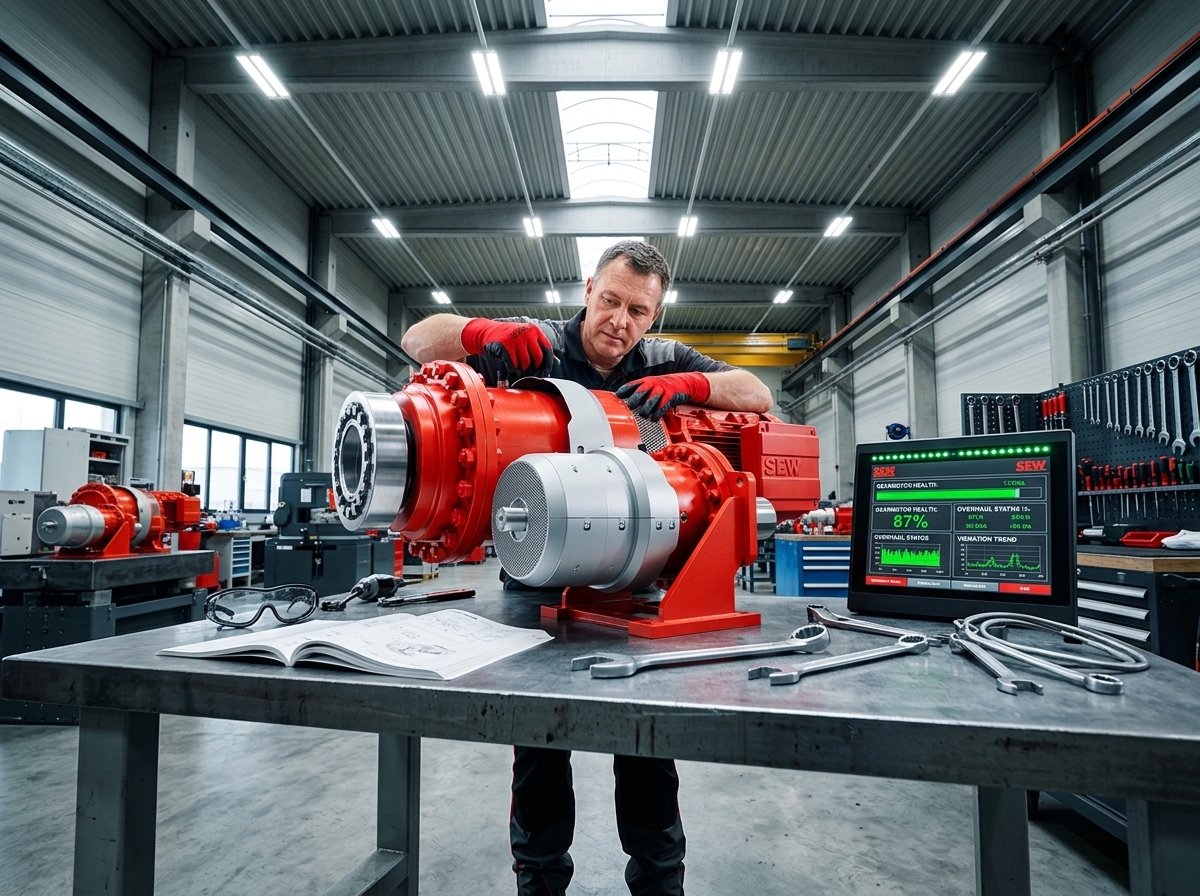
Which gearmotor repair method should you choose?
Once you’ve decided to repair, there are four common routes. They differ mainly in downtime, cost and whether the unit comes back better than original.
| Method | What happens | Best when | Trade-off |
|---|---|---|---|
| On-site service | A technician repairs the unit in place. | The fault is reachable without full teardown (seal replacement, alignment) and moving the unit would add downtime. | Not every fault can be diagnosed or fixed on site. |
| OEM rebuild | A shop rebuilds the unit to original specification with original parts. | Wear is spread across several components and long-term reliability matters more than speed. | Longest turnaround: full teardown, parts and testing. |
| Exchange unit | A tested unit is swapped in immediately; the original is repaired afterwards. | Minimizing downtime is the priority. | Only works if a matching unit is in exchange stock. Confirm this in advance for critical assets. |
| Retrofit upgrade | The unit is repaired and upgraded, for example with monitoring sensors, a higher-efficiency motor or better seals and materials. | Operating conditions have changed since installation, or there’s a recurring failure such as repeated seal failures in washdown. | Extra cost and lead time; worth it when it fixes a known problem. |
How do you choose between the repair methods?
- What does an hour of downtime cost on this asset, compared with the price difference between an exchange unit and a rebuild?
- Is a matching exchange unit actually available now? If you’d have to wait for one, its speed advantage disappears.
- Has the operating environment or duty cycle changed since the unit was installed? If so, a retrofit can fix the cause rather than the symptom.
Where SEW-EURODRIVE fits in
As one example, SEW-EURODRIVE Canada repairs drive technology at its three Drive Technology Centres, serving western, central and eastern Canada, where units are diagnosed and the customer receives a full report. It also offers exchange units from Canadian inventory when downtime has to be kept to a minimum, and its Retrofit Service replaces installed drive technology with current SEW-EURODRIVE products. For step 5, its DriveRadar® IoT Suite monitors industrial gear units with smart sensors, edge processing and alerts that flag developing faults early, so repairs can be planned.
Related reading
- How predictive maintenance reduces downtime and improves OEE
- Adding condition monitoring to older drives and connecting it to CMMS/SCADA
Sources
- EASA: Repair or replace? Research reveals criteria end users consider
- EASA: Repair-vs.-replace discussions need to be grounded in evidence
Last reviewed: October 2026