When a critical gearmotor fails, every hour of downtime costs — but the more expensive mistake is often making the wrong repair-vs-replace call under pressure. This framework lays out the actual decision criteria maintenance teams use, so the choice is based on data rather than urgency.
Evaluating Gearmotor Repair Options
Step 1: Diagnose the Failure Mode
Before costing anything out, identify why the unit failed:
- Wear-related (bearing wear, gear tooth pitting under 20% of contact area) → usually repairable
- Contamination (water/debris ingress) → often repairable if caught early, but check for secondary damage
- Catastrophic (cracked housing, sheared shaft, multiple simultaneous component failures) → typically points to replacement
Step 2: Apply the Cost Threshold Rule
A widely used industry rule of thumb: if repair cost exceeds roughly 60% of a new unit’s price, replacement is usually the more economical path — particularly for smaller, off-the-shelf gearmotors, where new units are often cheaper than a full teardown repair. For larger, custom, or high-value gear units, remanufacturing is frequently more cost-effective than replacement, especially when the housing and major components are still sound.
Step 3: Weigh Asset Criticality
The same failure on two different machines can call for two different decisions. Ask:
- Does this unit’s downtime stop the whole line, or just one station?
- What’s the actual cost-per-hour of downtime for this asset?
- Is there redundancy or a spare on hand?
Step 4: Check Parts Availability and Obsolescence
Step 5: Factor In Condition Monitoring
Putting It Together
| Factor | Favors Repair/Overhaul | Favors Replacement |
|---|---|---|
| Failure mode | Wear, minor contamination | Catastrophic, structural |
| Repair cost vs. new unit | Under ~60% | Over ~60% |
| Asset criticality | Redundancy available | Single point of failure |
| Parts availability | In stock / remanufacturable | Obsolete, long lead time |
| Monitoring in place | Caught early via sensors | Failure was sudden/unmonitored |
Where SEW-EURODRIVE fits in:
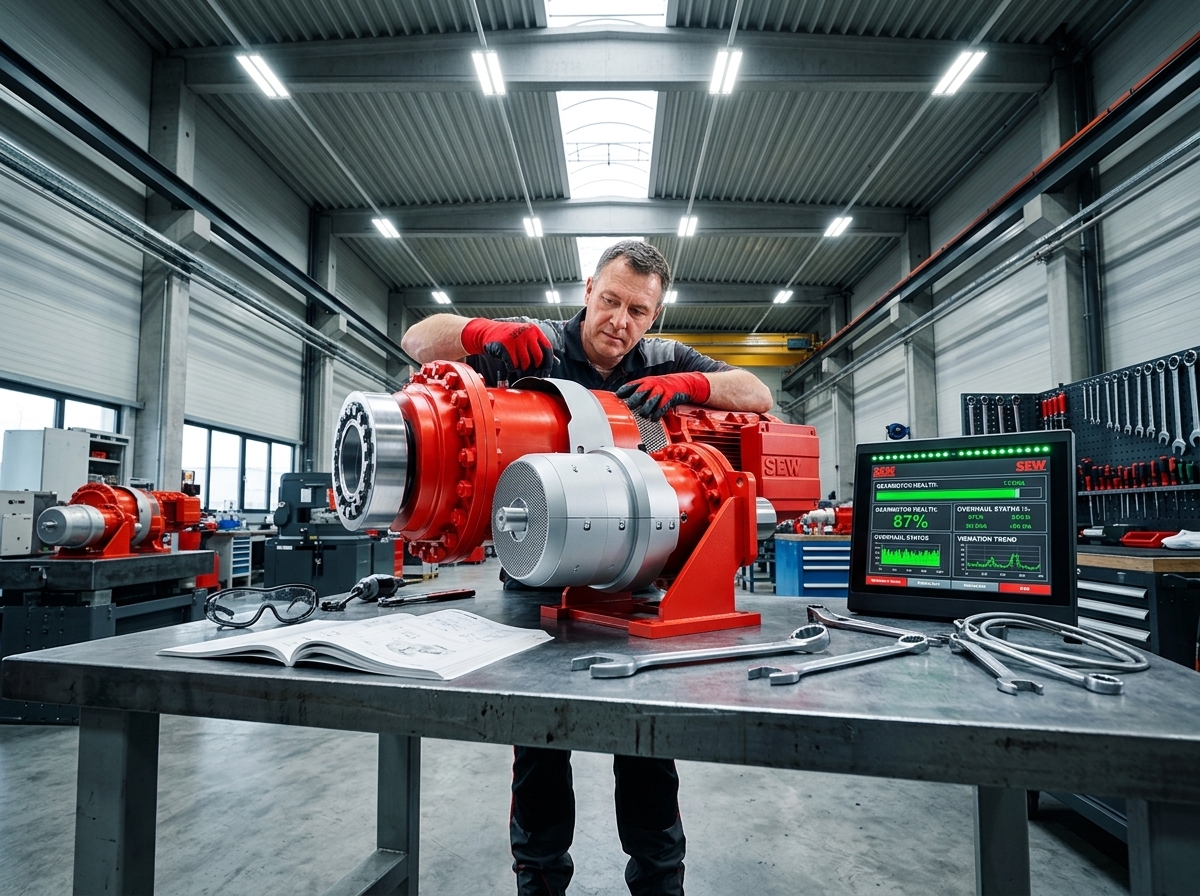
Condition-monitoring platforms — such as SEW-EURODRIVE Canada’s DriveRadar — are one example of how Step 5 gets implemented in practice: continuous tracking of vibration and temperature data flags degradation early enough that the repair/overhaul/replace decision in this framework can be made on a planned schedule rather than during a shutdown. For gearmotors already in service, SEW-EURODRIVE Canada also offers emergency repair and rebuild support if you need a second opinion on which path applies to your equipment. More Information available at https://sewcan.ca/