Gearmotors.ca is published by SEW-EURODRIVE Canada. Product examples refer to SEW-EURODRIVE; the guidance applies to equipment from any manufacturer. About this site
Short answer: Food, beverage and chemical lines are harder to automate than general material handling because they change products often, adjust motion settings by recipe, keep many axes synchronized, and stop regularly for cleaning. Motion control software helps by replacing custom programming with configurable settings, using electronic camming and gearing to keep axes in step, and managing machine states in a standard way so lines stop and restart predictably.
Why are food, beverage and chemical lines harder to automate?
| Challenge | What it looks like on the line | Why it costs time |
|---|---|---|
| Frequent changeovers | One packaging line runs several products a day, with different container sizes, fill volumes or case-pack formats. | Each change can mean re-tuning several axes by hand. |
| Recipe-driven settings | Speed, torque and position change with the recipe or batch being run. | Settings must change reliably every time, not just at commissioning. |
| Multi-axis synchronization | Filling, capping, labelling and cartoning stations must stay in step with each other. | One axis drifting out of phase can jam the line or cause defects. |
| Cleaning downtime | Washdown and clean-in-place (CIP) cycles are required in food and beverage production. | Every minute of cleaning is lost production, so a fast, reliable restart matters. |
How does motion control software reduce changeover time?
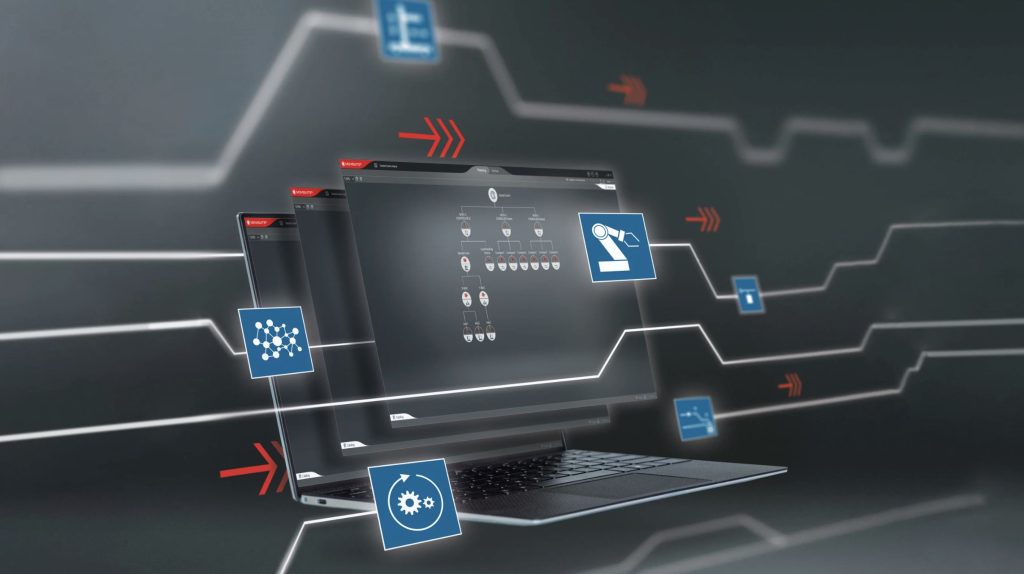
Instead of an engineer writing new control logic for each product, the motion functions are built once and then configured with parameters. Changing products becomes a matter of selecting or adjusting a parameter set, often through a graphical interface, rather than reprogramming. This shortens changeovers and reduces the risk of errors when a line switches between recipes.
How are multiple axes kept synchronized?
Electronic camming and gearing link each axis to a master reference, such as a main conveyor or an infeed sensor, in software. Gearing keeps an axis at a fixed ratio to the master; camming lets it follow a defined motion profile relative to the master, for example to match a moving product and then return. Because this happens in software rather than through mechanical cams and line shafts, the relationship can be changed when the product changes.
What is PackML, and why does it matter after cleaning?
PackML is a standard approach to machine states and modes for packaging machines, published by ISA as technical report ISA-TR88.00.02 and promoted by OMAC. It defines common states such as stopped, idle, starting, execute, held and aborted, and how a machine moves between them. When every machine on a line follows the same state model, operators see consistent behaviour, line control is simpler to integrate, and restarting after a stop or a cleaning cycle follows a predictable sequence instead of custom logic for each machine.
Which motion functions are common on packaging and filling lines?
- Rotary knife and flying saw: cutting continuous material, such as film or packaging stock, to length while it keeps moving. Typical of form-fill-seal packaging.
- Pocket and smart belts: turning a continuous flow of product into evenly spaced positions, for example before case packing.
- Pick-and-place and multi-axis positioning: moving products between conveyors, into cases or onto pallets.
- Winding and unwinding: controlling tension and speed on reels of film or labels.
Where SEW-EURODRIVE fits in
As one example, SEW-EURODRIVE’s MOVIKIT® software modules let motion control and drive functions be configured through graphical wizards in the MOVISUITE® engineering software instead of programmed. They run on the MOVI-C® CONTROLLER. Its AutomationFramework includes a PackML-compatible state and mode manager and application modules for packaging machines, including Rotary Knife, Flying Saw, Pocket Belt, Smart Belt, Winder and Robotics, and MOVIKIT® also includes DriveRadar® modules for monitoring.
Related reading
- Industrial automation technologies worth evaluating for Canadian plants
- How predictive maintenance improves OEE
Last reviewed: October 2026